Minolta Dynax 7: an ongoing review
Model Nicola Paige, shot at Altona Beach on the Minolta Dynax 7, using Kodak Gold 200 film. This is a horizontal crop of the vertical version below; i.e., this is much larger than it reasonably should be presented.
I grew up with a Minolta X-GM film camera. I used it as a child, I used it at work in my twenties, I used it when I returned to film in my late 40s, and I was using it in 2025 – when it stopped working. There isn’t much that can go wrong with an X-GM but the fix was about three times more expensive than the market value of the camera. I still may well get that camera fixed, but in the meantime I’ve started shooting with a Minolta Dynax 7. The appeal of the Minolta ecosystem was a) sentiment and b) my dad, who is in his late 80s, never transitioned to digital, and still shoots many rolls of film every year. He uses a Minolta Dynax 300 si, and has some lenses. I figured that being in the same ecosystem made sense.
Going from a Minolta X-GM to a Dynax 7 (or a-7) is, in analogue camera terms, a bit like going from a skateboard to a car. The Dynax 7 has got a lot of capability beyond mere point and shoot, including memory of settings and films, including (famously) a rear screen, including various autofocus modes and, even, various ways to trigger flash. This means that it has a lot of electronics, which means that there’s a lot that can go wrong (see below).
By way of history: the Minolta Dynax 7 model arrived on the market in 2000, in the last days of the SLR’s reign. It’s a camera that was built when autofocus and electronics had matured, but before digital had descended. The Minolta Dynax 7 is often described as one of the most refined film SLRs ever made. It’s also described as the last serious enthusiast body Minolta released – before it was absorbed into Konica Minolta and, eventually, Sony.
A note on names: the Minolta Dynax 7 was sold as the α-7 in Japan and the Maxxum 7 in the USA. The "a7" shorthand causes some confusion with Sony's later α7 mirrorless cameras, which are of course completely different.
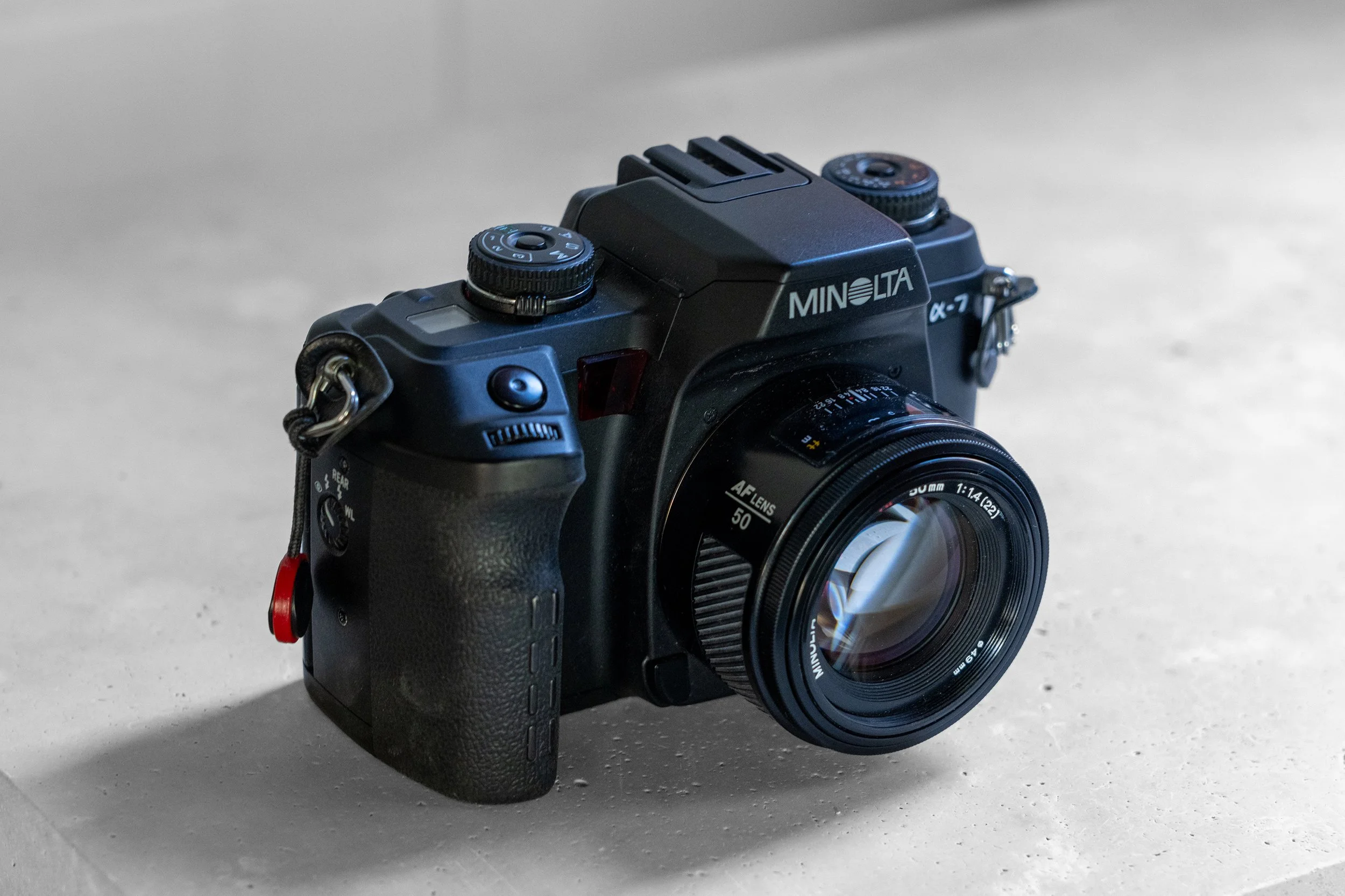
Below is a picture of the actual camera I’m using (pictured here with a 50mm f1.4 lens). I bought it (from Japan via eBay seller toyo_camera_japan; I’m in Australia) in 2025. I’ve shot about six or seven rolls of 36 on it and have had some issues but have also had some successes. I get my film developed and scanned by Ikigai Film Lab in Williamstown North (Melbourne), usually on their Frontier scanner. I’ll set out some details of this camera, give an impression of my shooting experience so far, and share a number of images (below). All these images were (obviously) taken in 2025 and 2026.
What it is
The Minolta Dynax 7 is a 35mm autofocus SLR using Minolta's A-mount. The A-mount lens system carried through to Sony's A-mount bodies, so there's a deep, affordable pool of glass, both Minolta and later Sony. The Dynax 7 also became the template for Minolta's digital future – the Dynax 7D digital SLR of 2004 was based on it.
Model Casey Barclay in Melbourne, shot on Kodak Gold film with the Minolta Dynax 7 camera. This was my first outing with this camera and fair to say – courtesy of user error – focus was an issue. The above image is slightly out but it still works. The image below of Casey is focussed.

Key features
Autofocus: nine sensors – eight line sensors and one central double-cross – with AF-A, AF-S, AF-C and DMF modes and an AF assist light. DMF lets you fine-tune focus by hand after the camera has locked on.
Eye-start: sensors in the grip start autofocus as you raise the camera to your eye.
Metering: 14-segment honeycomb, centre-weighted and 2.7 per cent spot.
Exposure modes: program with shift, aperture priority, shutter priority and manual, plus three subject programs, with exposure compensation of ±3 stops in half or third steps.
Shutter: tops out at 1/8000 second, with flash sync at 1/200.
Viewfinder: a pentaprism with 0.80x magnification and roughly 92–94 per cent coverage – large and bright for its class.
Flash: a built-in pop-up flash with rear sync, slow sync and ADI metering.
Customisation: 35 custom functions, which let you reshape much of how the camera behaves.
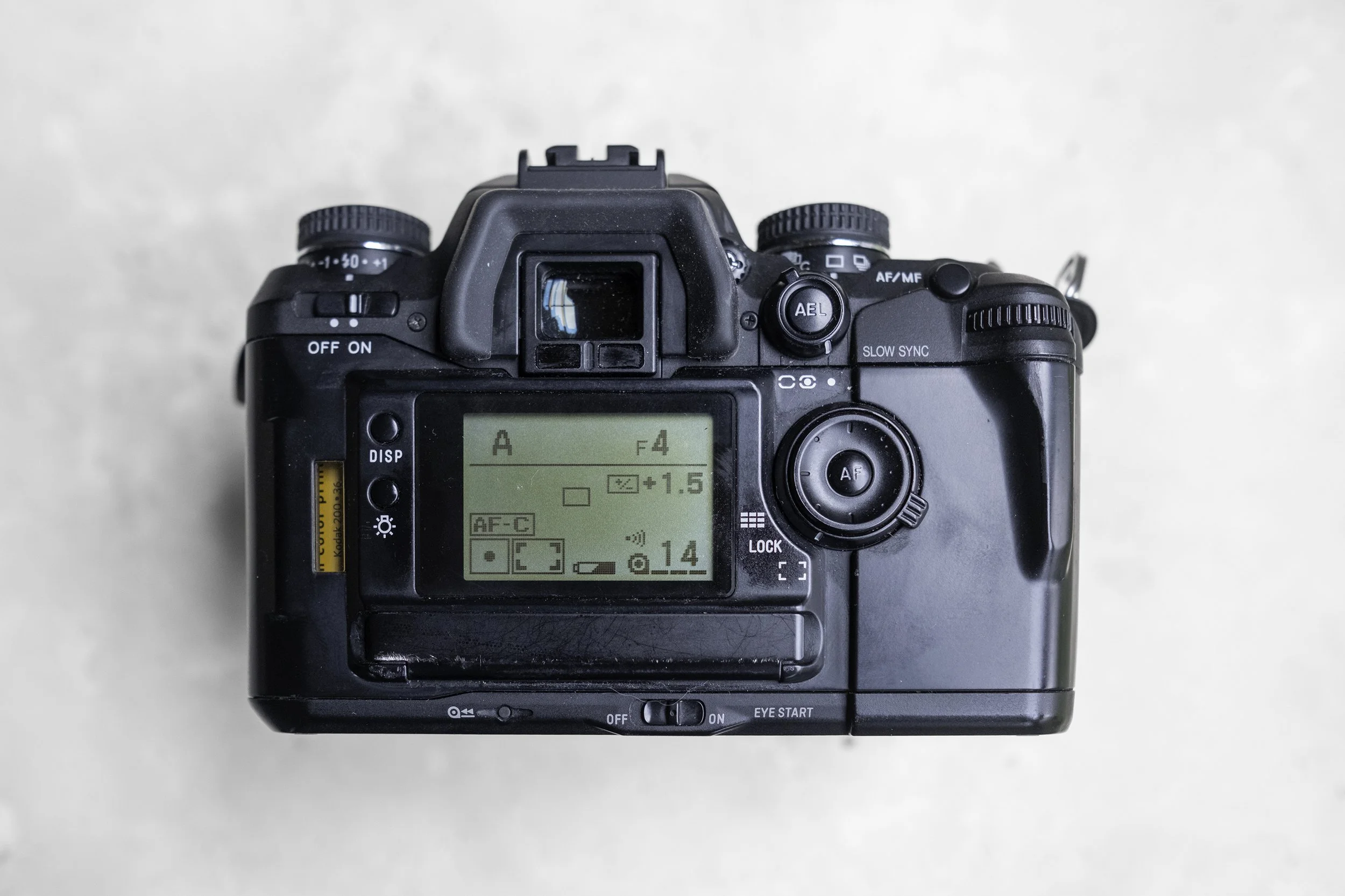
The rear panel: the Dynax 7's signature. A large LCD on the back gives a graphic readout of shutter speed, aperture, metering and more – unusual on a film camera, and the feature most owners mention first.
Data memory: the camera records exposure data (shutter speed, aperture and more) for each frame across multiple rolls, which can be read back on the rear screen.
Why it's worth a look now
First, the bad news. In the specs this camera has a top frame rate of (almost) 4 fps – not, given film prices, that I imagine too many people wanting to use this camera for high burst shooting, or not too often. In any case, for my camera specifically, burst rate is immaterial; I get an error message after every single frame, and this message renders the camera inoperable. The fix is, for me, to re-cycle through “turning it off and on again”, which then brings the camera back to full functionality. This is a common fault with this camera – I’ve tried the various re-set routines, and nothing has helped – but it means that I have to turn the camera off, and turn it on again, after every frame.

That’s pretty annoying and it does, without doubt, put a dent in my enjoyment of this camera. When I’m walking around taking images of houses, buildings and objects though, as I often do, I barely notice it, mostly because digital cameras have put me in the habit of turning the camera off every time I move shooting positions.
The Kororoit Creek Fishing Village, in Williamstown North in Melbourne, on the Minolta Dynax 7 – this time on Portra 400. All the landscape shots here are on Portra 400. Shots like this are a breeze with the Dynax a7.


Here’s the thing though: I have a slightly busted version of this camera, and it’s been like this from the day that I received it (I should have returned it; I didn’t) and yet all the images on this page were taken with this camera (except for the pictures of the camera itself).




JP Marin, shot on Kodak Portra 400, with the Minolta Dynax 7.
And this is without me yet getting the full hang of the best autofocus settings, and without me putting a great many rolls through it thus far.

Every shoot, though, has produced a swag of images that I either love or am happy with. I’ve only shot for fun on it but I would happily shoot with it professionally – so long as I had a back-up with me. It’s a camera that feels good in the hand. It looks solid and professional. It sounds electronic but it still sounds clearly analogue. And it performs.
Edison Hernandez – Melbourne Creator – shot on the Minolta Dynax 7 on Kodak Portra 400, at the Williamstown Botanical Gardens. This is camera, lens and film stock working in harmony.
Images like the below would happily sit in a high-grade magazine. There’s a proviso that applies to all electronic-based film cameras: the electronics might bust, and getting them fixed can be either difficult or impossible. But if you can find a copy of this camera that’s in excellent condition, from what I have experienced so far, it does churn out the hits.