
Real Estate Novelist
I’m a journalist. I’m a novelist. I’m a photographer.
The Real Estate Novelist series combines all three. It’s where I take portrait photographs of houses and buildings, in their landscape, as they are.
—
THEY BULLDOZED my childhood. They knocked down my primary school, my secondary school, the houses in my street, the trees I climbed. What they didn’t knock down, they sub-divided and suffocated. I live within a kilometre of the hospital where I was born, and rent my childhood home as an office. Every day I walk the streets that I have walked for the entirety of my life; every day I look for the markers of home; every day I can’t find them. Everything was scrapped. Everything was changed. Everything was knocked over and done again. I live in a townhouse development that was built on land that was once a caravan park for permanents. The cost of being the working poor is that your history has no value. They would never raze the rich schools. They would never uproot the tree-lined promenades. The mature trees in my street were knocked over without even a letter. The schools I went to were not just razed, but re-named. The story of modern Australia is the story of people being priced out of the places they call home. The story of modern Australia is a story of refugees from without, and refugees from within. The story of modern Australia is one of a people whose lives are constantly being overwritten.
What is left, what hangs on, becomes more precious, demolition by demolition.
I take this sensibility – this respect for home, and for what has come before it – and apply it, photographically. I’m a portrait photographer. I developed my skills taking portraits of people. I now take portraits of buildings and houses. I do so for the love of them. For the dignity of them. As a document of respect.

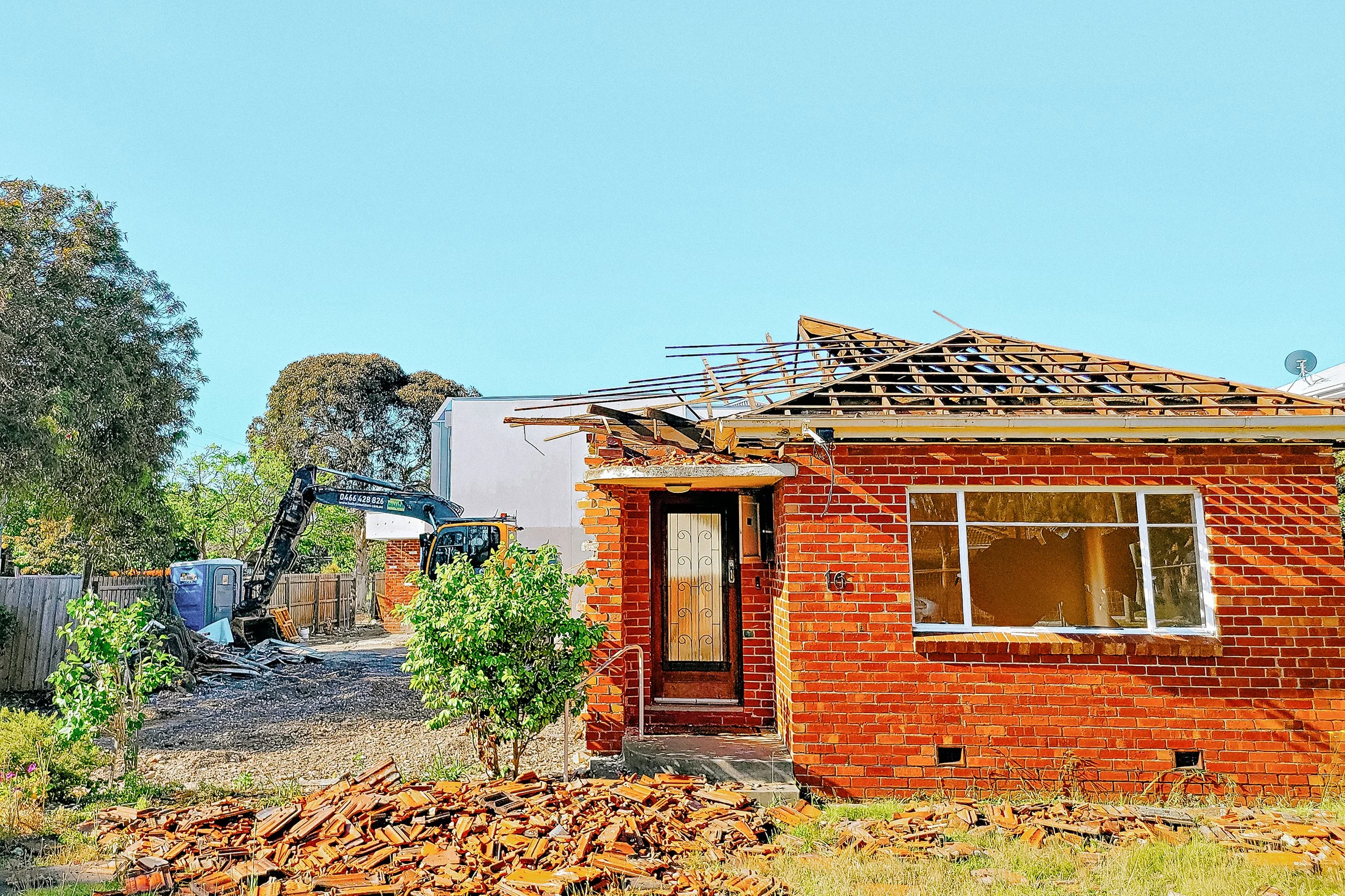
That Altona house on Civic, with the grass all around
I took a photo of a house in Altona. I liked the light, I liked the house, I liked the colours. There was a tree on the nature strip and a tree in the front garden, though, and so it was hard to get the right angle. I looked at this photo, back at home, and thought: I like this photograph quite a lot, but the framing is slightly too tight. The house itself needs more headroom, more sky. I probably needed to stand on the road to get the shot right. So I waited for the right weather conditions and then went back to photograph the house again. A couple of weeks, only, had passed. The house was gone.
__
I’ve looked at this photo a lot since. The house was old and overgrown, sure, but it hadn’t occurred to me that these were its last days. It now feels as though it was a privilege to capture this house (below), sitting there in the sun, on what turned out to be its death bed.
It was the last chance to see. It’s why now, when I see a house standing in beautiful light, I think, If I don’t capture it now, I might never get the chance again.
The Corner of Rosshire & Basil
Every morningof my primary school years I walked past this house. It was on the corner; its side fence faced west, and copped the late sun. Until recently this house was rented by a young family. The front yard was always strewn with toys, balls, trucks, spades and plastic cars. I knew that this family had moved out when the toys on the lawn disappeared. I noticed then, too, that all the curtains had been left wide open.
A few days later the services to the house were cut; the water, the electricity, the gas. Wire barricades went up. Shortly after, the bulldozers smashed through.
It’s the details that get you. I’ve never known any of the inhabitants of this house, for all the time that I’ve known it. But I’ve admired that simple-but-ornate glass front door for as long as I can remember.
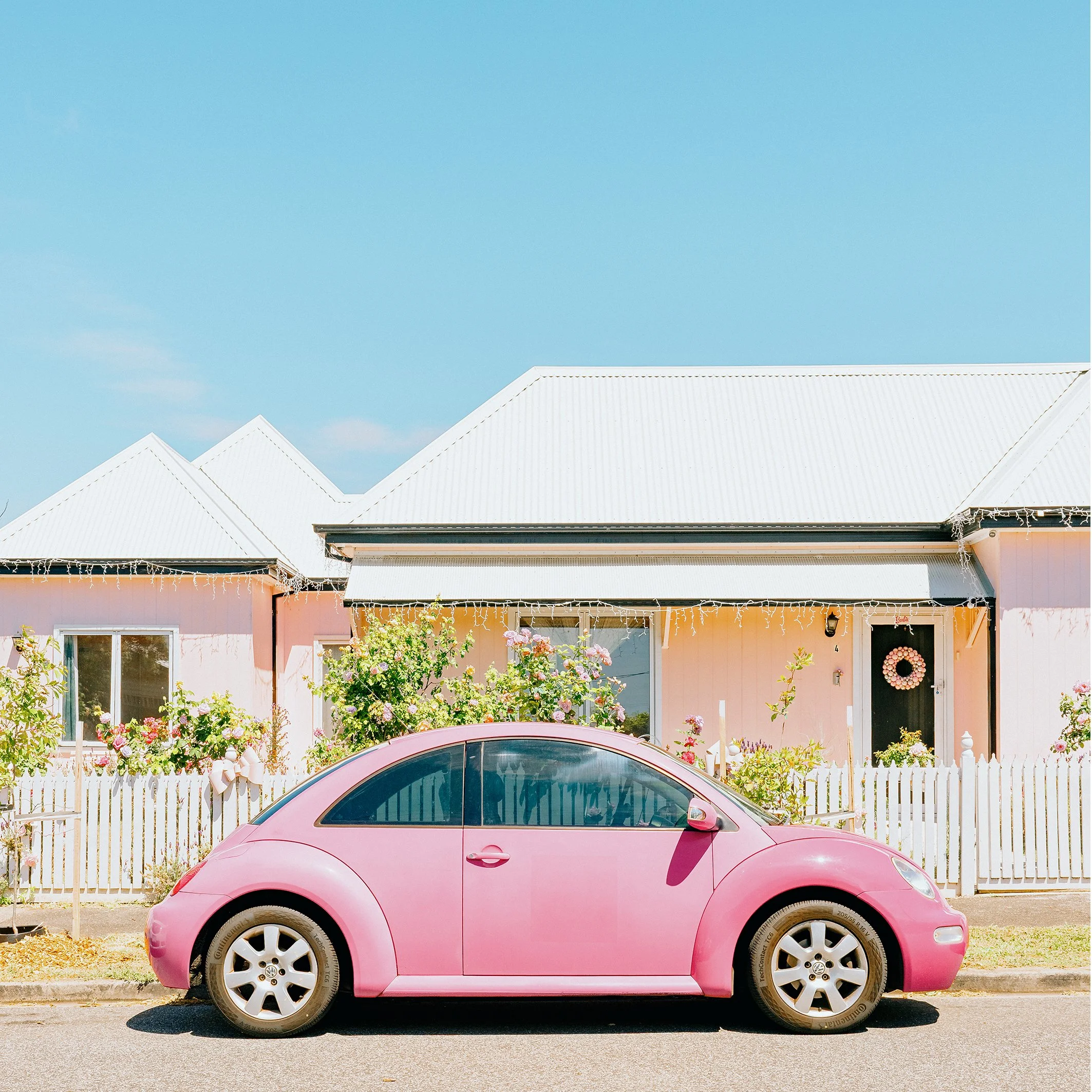
Cars don’t kill the picture.
They make it.
When I first started taking pictures of houses, I was often frustrated when cars (or people) were in the way of the shot. I slowly realised though that cars weren’t in fact marring the shot; they were making it. Nothing quite places an image – in time – quite like a car. Every car model will one day be a vintage car model. The most ordinary of photographs from the 1950s and 1960s can be full of character and merit if, simply, there are cars, buses or trucks in it. The same will be true of the photographs of today. The bulk of my images are no doubt car-less. But rather than avoid cars in shots, I now often deliberately include cars in these portraits of houses and buildings. I’ll even include people, should they walk into frame.
Real Estate Novelist – Series.
Most posts in the Real Estate Novelist Series are single images. Many are photo essays.


"Entry". A house in Yarra Street, Williamstown with bushes growing over the entrance. Copyright Campbell Mattinson.

A beautiful weatherboard house in Civic Parade, Altona.

Photo of the Hot Wings Charcoal Chicken shop on the corner of Ferguson Street and Melbourne Road, Williamstown.

Photo of the shops in Hall Street, Newport. A feature of these shops is a pink building and a tattoo parlour.

TiC Retail Accessories, Blackshaws Road, Altona North, 2022.

Blackshaws Road, Altona North, 2022.
Photo of Hosking and Son Electrician in Effingham Street, Newport.

Anchorage Avenue, Williamstown.

Portrait of The Orange Jeep. Parked on the corner of The Strand, Williamstown.

Parking on Waterfront Place, Williamstown North.
Hosking & Son Electrician, Newport
Campbell Mattinson photographs the Hosking & Son Electrician building in Effingham Road, Newport.

Bus stop at Williamstown Beach.

A couple walk along the esplanade at Williamstown Beach.
Photo of Hosking and Son Electrician in Effingham Street, Newport.
Photo of the Hot Wings Charcoal Chicken shop on the corner of Ferguson Street and Melbourne Road, Williamstown.
Photo of the shops in Hall Street, Newport. A feature of these shops is a pink building and a tattoo parlour.
TiC Retail Accessories, Blackshaws Road, Altona North, 2022.

Portrait of the Pantelis service station on the corner of Yarra Street and Douglas Parade, Williamstown.
Blackshaws Road, Altona North, 2022.

Williamstown Beach carpark.
A beautiful weatherboard house in Civic Parade, Altona.

Hatt Reserve, Williamstown Esplanade.
"Entry". A house in Yarra Street, Williamstown with bushes growing over the entrance. Copyright Campbell Mattinson.
Anchorage Avenue, Williamstown.

Ford Falcon, Williamstown South.

Hit of cricket. Hatt Reserve, Williamstown.

Shapes. Thorpe Street, Newport.
Portrait of The Orange Jeep. Parked on the corner of The Strand, Williamstown.

The House at the end of Maddox Road. This house, pictured in early 2022, was part of the fishing village on the estuary side of the Grey Reserve, Williamstown. This house has since been removed.

Challis Street shops, 2025.
Altona House.
Parking on Waterfront Place, Williamstown North.

Two older men with tanned skin on a beach. One man is sitting on rocks wearing a white sun hat and swimming trunks. The other man is standing in the shallow water, shirtless, wearing a red cap and dark shorts. They are near the water's edge with clear water and some rocks and seaweed around.

Paisley Drain, Williamstown North.

Two men on a pier by the ocean, one shirtless wearing swimming trunks and goggles, holding out a smartphone toward the other man, who is dressed in a dark t-shirt and shorts, with a cloudy sky overhead.