
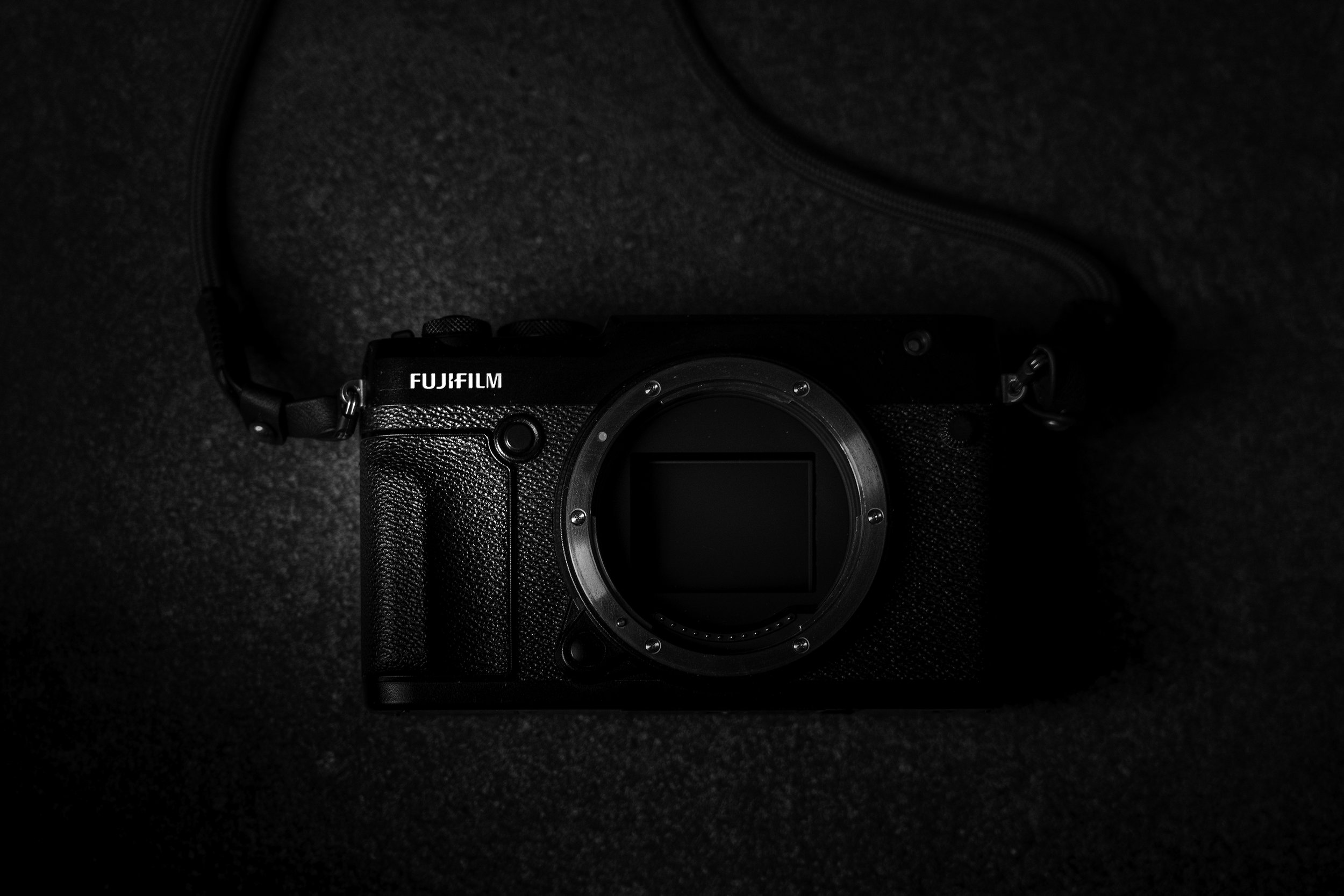
My trusty companion: a Fujifilm GFX 50R.
In 2026 I was handed an assignment that, when I looked at the brief, demanded the highest dynamic range possible. I own a Fujifilm GFX 50R and have done for five years. For still photographs the 50R has arguably been my most loved camera of all time, despite (or partly because of) its chunky, bulky, brick-like body. I also own a Sony a1 (the original), and I've owned a Sony a7R IV in the past, though I no longer do. For a brief time I also owned and used the original Nikon Z7. This project made me ask the question: do I have class-leading dynamic range at my disposal, and if I don't, how far off am I?
It also made me ask: can I afford to own class-leading dynamic range, and if I can't – what's the best-value dynamic range currently available?
The below sorts these questions out.
[Updated October 2026]
Dynamic range is the quality that lets a single frame hold a bright sky and a dark foreground without one of them giving up. It's the difference between a shadow you can lift cleanly and one that turns to mush, and it's the spec that matters most to landscape, architecture and available-light photographers. It's also the spec most cheerfully inflated by manufacturers. Claims of "15 stops" are engineering measurements taken down to a signal-to-noise ratio of 1:1, which is to say noise. They're not wrong, but they're not usable range either.
The figures below use a stricter and more useful yardstick: Photographic Dynamic Range (PDR), as measured independently by Bill Claff at Photons to Photos. PDR sets the noise floor where an image still looks like a photograph in a normal-sized print, so the numbers are lower than the brochure figures, but they compare like with like across brands and formats. All values are peak PDR at base ISO with the mechanical shutter, which is the best case for every camera here.
Five cameras now sit within a tenth of a stop of each other at the top of the mirrorless table. They get there by two different routes. Fujifilm's GFX100 II and GFX100S II and Hasselblad's X2D II 100C do it the old-fashioned way, with a 44 x 33mm sensor that is roughly 70 per cent larger than full frame. Sony's a7R VI and a7 V do it with a dual-gain readout that reads each pixel twice in one exposure, one pass for the shadows and one for the highlights. They're the first full-frame cameras to match medium format on this measure, though both give more than a stop back the moment you switch to the electronic shutter.
| Camera | Sensor | Peak PDR | Stops, scaled |
|---|---|---|---|
| Sony a7R VI | Full frame 36 x 24mm 67MP, base ISO 100 – 11.4 with electronic shutter | 12.56 | |
| Fujifilm GFX100 II | Medium format 44 x 33mm 102MP, base ISO 80 | 12.55 | |
| Fujifilm GFX100S II | Medium format 44 x 33mm 102MP, base ISO 80 | 12.49 | |
| Sony a7 V | Full frame 36 x 24mm, partially stacked 33MP, base ISO 100 – 11.0 with electronic shutter | 12.47 | |
| Hasselblad X2D II 100C | Medium format 44 x 33mm 100MP, base ISO 50 | 12.46 | |
| Fujifilm GFX100S | Medium format 44 x 33mm 102MP, base ISO 100 – discontinued 2024 | 12.33 | |
| Fujifilm GFX 50R | Medium format 44 x 33mm 51MP, base ISO 100 – 2018 sensor | 11.86 | |
| Sony a7R V | Full frame 36 x 24mm 61MP, base ISO 100 | 11.70 | |
| Sony a1 II | Full frame 36 x 24mm, stacked 50MP, base ISO 100 | 11.61 | |
| Sony a1 | Full frame 36 x 24mm, stacked 50MP, base ISO 100 | 11.52 | |
| Canon EOS R5 Mark II | Full frame 36 x 24mm, stacked 45MP, base ISO 100 | 11.45 | |
| Nikon Z8 | Full frame 36 x 24mm, stacked 45MP, base ISO 64 | 11.32 |
Peak Photographic Dynamic Range in stops, base ISO, mechanical shutter. Source: Photons to Photos (photonstophotos.net), figures current to October 2026. Bars are scaled from 11.0 to 12.8 stops to make the gaps visible; a difference of less than about a third of a stop is not something you will see in a print.
What the above dynamic range table says
The gap between the top and bottom of this list is about 1.2 stops. The cameras fall into two groups, with a clear step between them. The stacked-sensor speed cameras – the Nikon Z8, Canon R5 II and both Sony a1 models – cluster between 11.3 and 11.6. Their sensors are built to read out fast, and a little dynamic range is the price. The 61MP Sony a7R V and Fujifilm's 50MP medium format sensor sit just above them, at 11.7 and 11.9, which is where full frame had plateaued for the better part of a decade. Then there's a jump of close to half a stop to the 100MP medium format group and the two dual-gain Sonys.
Beyond all of these sit the Phase One IQ4 and Hasselblad's H6D-100c. Both of these use a larger 53 x 40mm sensor and add roughly another two-thirds of a stop again. They're the true ceiling, but at the price of a car and with the working speed of a view camera, so they belong in a different conversation.
Conclusion
If you want the most dynamic range available in a camera you can carry around, the answer in 2026 is a five-way tie between the Sony a7R VI, the Fujifilm GFX100 II and GFX100S II, the Sony a7 V and the Hasselblad X2D II 100C, with the a7R VI a hair ahead on the numbers. Choose between them on everything else: the Sonys are the most versatile, with the fastest autofocus and the widest lens choice; the Hasselblad has the lowest base ISO, 16-bit files and the nicest – I’m told, I’ve not experienced it – handling, though it has no video at all; while the Fujifilms have the broadest lens range (in medium format terms), 8K video with ProRes on the GFX100 II, and the larger sensor's smoother tonality. On dynamic range alone you'd struggle to tell any of their files apart.
These cameras are the answer to my question: what camera has class-leading dynamic range in 2026?
Which brings me to the best-value dynamic range question
The value question has two answers. If you're buying new, the Sony a7 V is the clear pick: it gives up a tenth of a stop to the leader and costs less than half as much as any of the medium format bodies, and nothing else near its price comes within half a stop of it. If you want medium format, the original Fujifilm GFX100S is the camera that isn't the winner but might be the smartest buy. At 12.33 stops it gives up about a quarter of a stop to the current leaders, which is invisible in practice, and it's the only 100MP medium format body you can now buy used for well under half the price of a new GFX100 II. It was discontinued in 2024, so clean examples won't be around forever, but for a photographer who wants medium format range without a medium format bill, it remains the value pick of the field.
So there’s the answers.
Personal choice
Where that leaves me personally – I’m not sure. I have some GFX glass, so I’m tempted to trade in my 50R and find a GFX100S. I’m also tempted, for logistical reasons, to trade in the 50R and swap it for a Sony a7R V.
But gosh, if I could afford it, that Sony a7R VI does look supremely good.
And – and this really is the doozy of recent releases – the Sony a7 V has re-written what is possible in the more affordable (though still expensive) stakes.
Footnote: How the DSLR era compares
Anyone still shooting a good DSLR has less to feel left behind about than the table might suggest. The best of that era, the Nikon D850, measures 11.63 stops, with the Pentax K-1 II and Nikon D810 close behind it, and the medium format Pentax 645Z, which used the same 50MP sensor generation as the GFX 50R, sitting in the same band. That is level with the a7R V and the GFX 50R, and within a third of a stop of every stacked-sensor flagship on the list. The D850 was a BSI design, the same basic architecture as the sensors that followed it, and full frame stalled at about 11.7 stops from 2017 until this year. What finally moved the needle wasn’t the mirror going; it was a physically larger sensor first, and then Sony’s dual-gain readout. The DSLR era’s best is a stop off the current leaders, and no more.
—
Sources
Dynamic range figures: Photons to Photos, Photographic Dynamic Range chart
Sony a7R VI mechanical vs electronic shutter: PetaPixel, June 2026
Hasselblad X2D II 100C: PetaPixel, November 2025
Sony a1 and a1 II: PetaPixel, December 2024