The Tamron 90mm Macro – An Accidental Portrait Lens
Melbourne model Lucille King, wearing tennis gear, back lit, stands in front of the tennis net. This is shot on the Tamron 90mm F/2.8 Di III Macro VXD lens, at f2.8. PHOTO: Campbell Mattinson.
It happened by accident. But a portrait session with model Lucille King recently answered the question: is the Tamron 90mm F/2.8 Di III Macro VXD a good portrait lens? The short answer: Yes.
I spent an hour photographing Melbourne model Lucille King on the weekend. I had about 25 pieces of photography equipment with me (slight exaggeration), but I’d only bought a lens hood for one lens. This lens was the Tamron 90mm F/2.8 Di III Macro VXD lens. I had no intention of using this lens – I had all my most trusted portrait lenses in the bag – and yet I ended up using it for the entirety of the session. Yes, for a portrait session, I used nothing but a macro lens. This despite the fact that I had more suitable or customary lenses with me.
I’ve never used a macro lens for a portrait session before.
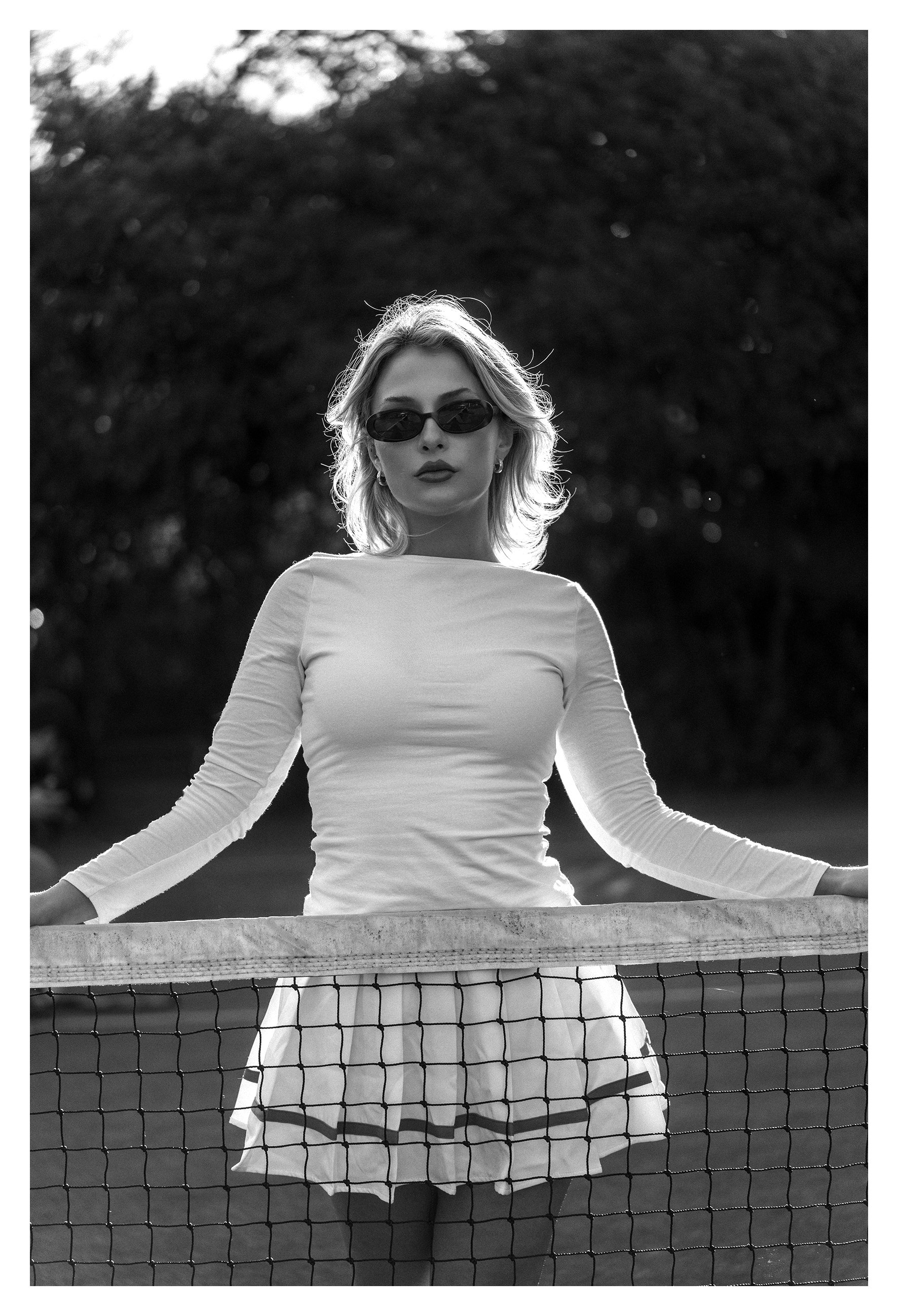
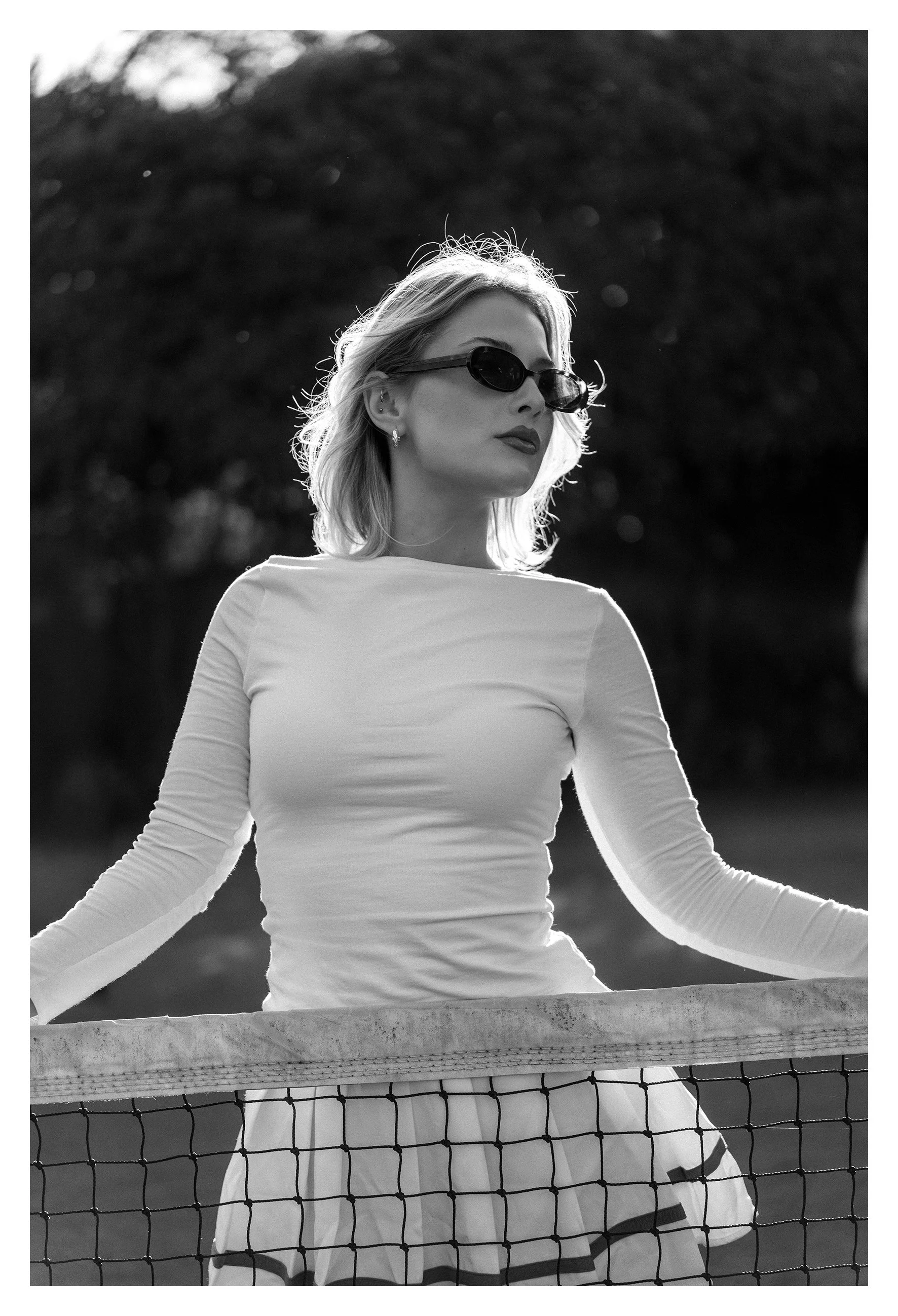
From standard distances, of course, there’s nothing that greatly differentiates a macro lens from any other. The reason I stuck with it though was simple: I took one look at the lighting conditions and figured that backlit/shooting into the sun was likely to produce the best shots. I not only had the lens hood with me for the Tamron macro lens; but the lens hood that this lens comes with is substantial. So there was a lot of flare going on, which is good, but it was also good to have a mitigating piece of kit in play.
Melbourne model Lucille King stands side-on to the camera, wearing tennis gear, on a tennis court, resting against the tennis net. This shoot was at a private residence in Surrey Hills. PHOTO: Campbell Mattinson.
So I shot everything on a macro lens. And 100% of the shots that I took were taken at f2.8. And with every shot, I had the lens hood attached. Normally I’d shoot a session like this with either a 50mm f1.4 or 85mm 1.4, and with those lenses attached I’d shoot (rightly or wrong) pretty much everything at f1.4. I’m also a shocker for leaving my lens hoods at home. So it was unusual for me to be shooting portraits with a lens hood too.
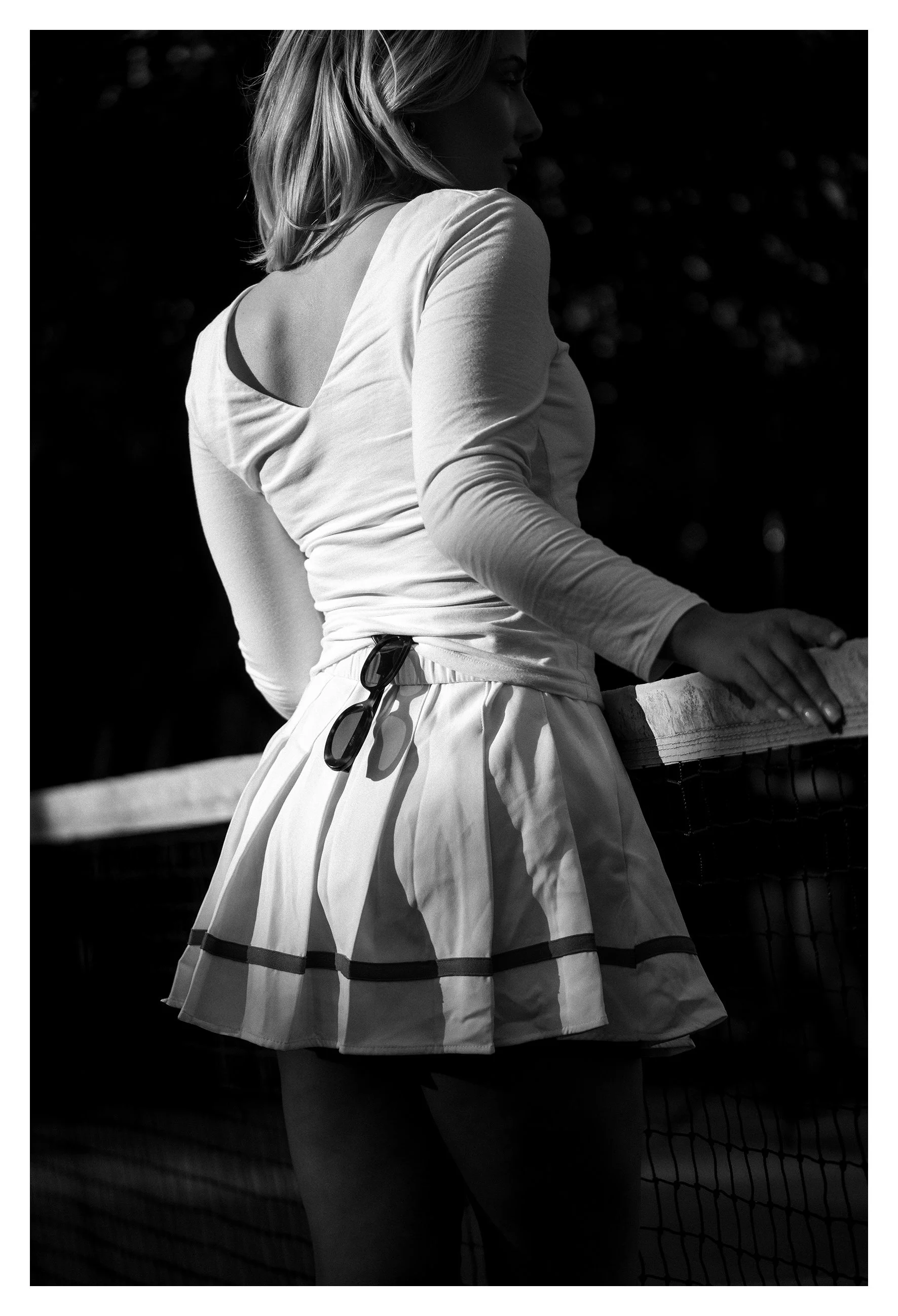
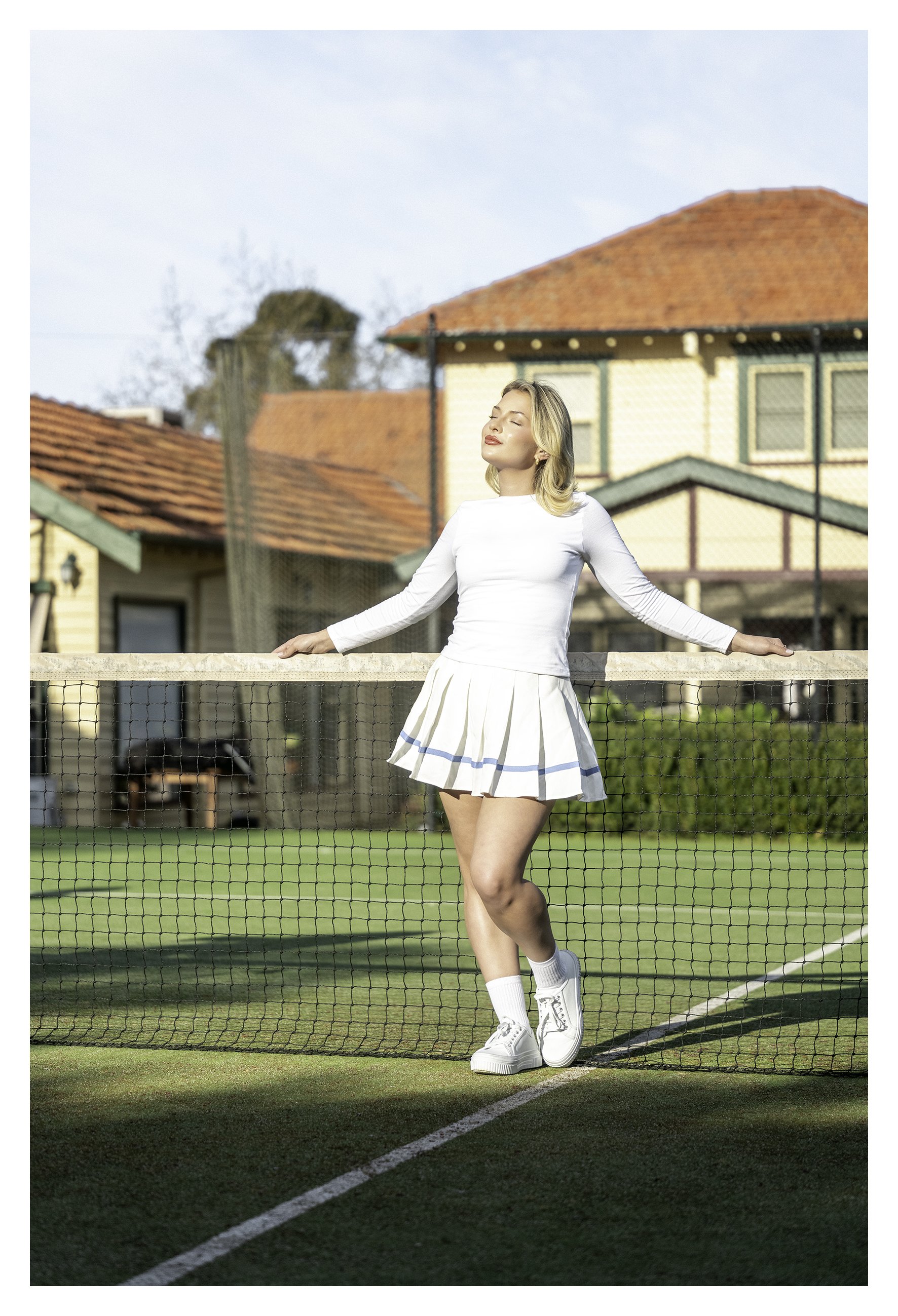
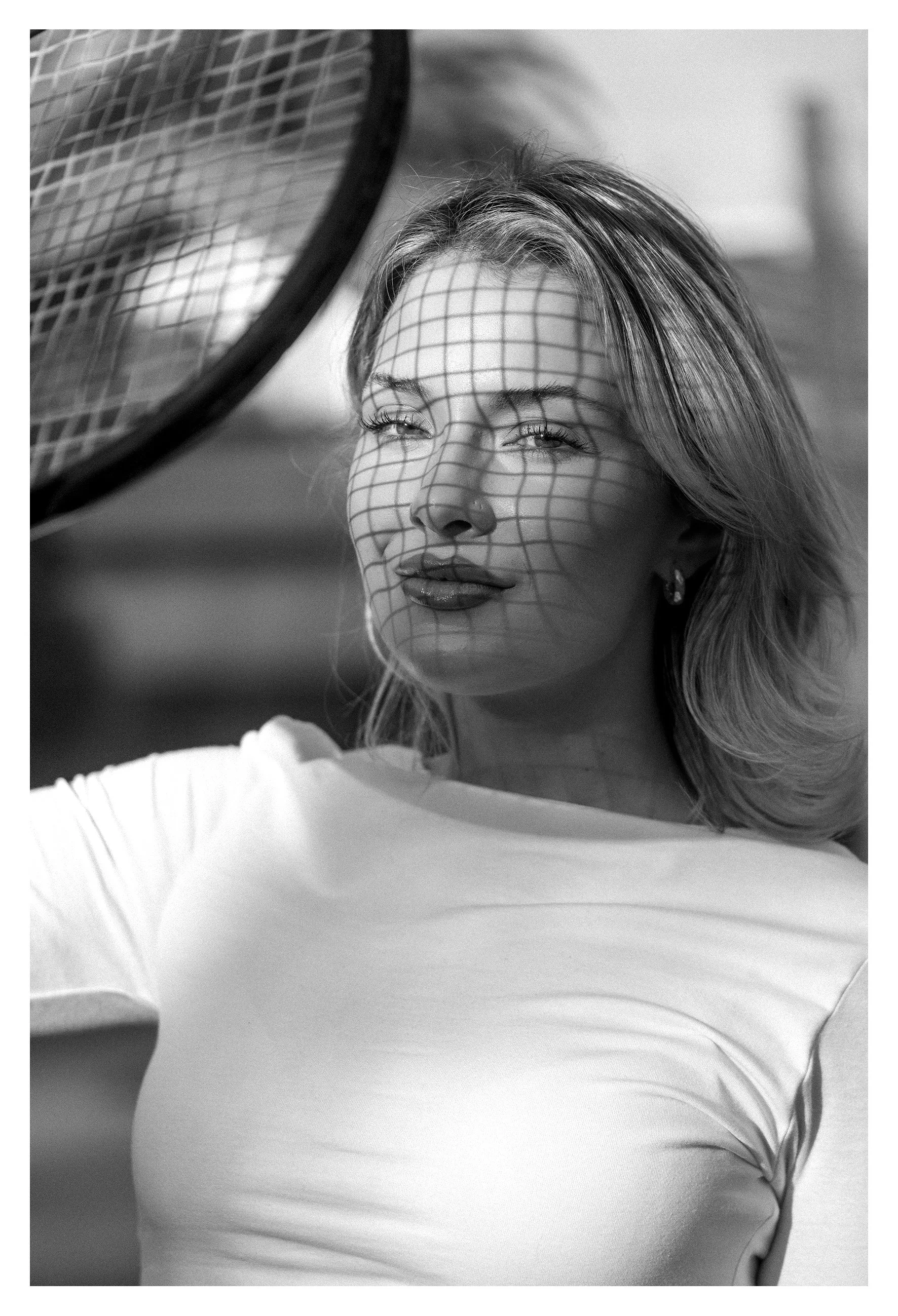
So here I am shooting a macro lens for a portrait session, at a different f-stop to what I’d normally use. I have this lens on my Sony A1 body. One thing I’ll say – and which is a bit of a lesson for me – is that being ‘forced’ to shoot at f2.8 rather than at f1.4 turned out to be a good thing. Look at the image below: Lucille is in focus, and the net is (more or less) in focus too. There’s still ample separation, but keeping both Lucille’s eyes sharp and the net sharp works nicely.
More than that: if definition of the net had been lost, the image would have been lesser.
Melbourne model Lucille King rests, on the ground, of a tennis court, wearing white tennis clothes, a tennis racquet and ball resting beside her. This is shot on the Tamron 90mm F/2.8 Di III Macro VXD lens, at f2.8. PHOTO: Campbell Mattinson.
Another thing that I’ll also note: this lens rendered these images beautifully. Focus speed was as good as normal, I never had to worry about distance from the subject, and the lens hood itself did a stellar job. I used this Tamron 90mm F/2.8 Di III Macro VXD lens as a portrait lens by accident, but next time it will be intentional. It’s a beautiful portrait lens.
FAQ
Is the Tamron 90mm f/2.8 Di III Macro VXD a good portrait lens?
Yes. Although it's designed as a 1:1 macro lens, the Tamron 90mm f/2.8 Di III Macro VXD works beautifully for portraits – its f/2.8 aperture, short-telephoto 90mm focal length and 12-blade circular diaphragm give flattering compression and smooth bokeh. I shot an entire portrait session on it, at f/2.8, and it rendered skin and backlight superbly.
How much does the Tamron 90mm f/2.8 Di III Macro VXD weigh?
It weighs 630g (22.2oz) in the Sony E-mount version, and 640g (22.6oz) in the Nikon Z-mount version – light for a macro lens, and comfortable to handhold for a full session.
What is the filter thread size of the Tamron 90mm f/2.8 Macro?
The filter thread is 67mm – the same size Tamron uses across most of its mirrorless lenses.
What is the minimum focusing distance of the Tamron 90mm f/2.8 Macro?
The minimum object distance is 0.23m (9.1 inches), measured from the sensor plane. That's the distance at which it reaches full 1:1 magnification.
What is the maximum magnification of the Tamron 90mm f/2.8 Macro?
It offers a maximum magnification ratio of 1:1 (life-size) – subjects are recorded on the sensor at their actual real-world size. On an APS-C body the effective reproduction is greater still.
What is the maximum aperture, and how many aperture blades does it have?
The maximum aperture is f/2.8 and the minimum is f/16. It uses a 12-blade circular diaphragm – Tamron's first – which keeps the bokeh near-perfectly round wide open and produces clean 12-point starbursts stopped down.
What is the optical construction of the Tamron 90mm f/2.8 Macro?
It has 15 elements in 12 groups, including LD (low-dispersion) elements, with BBAR-G2 coating to control flare and ghosting – useful when shooting into the sun, as I did here.
Which cameras does the Tamron 90mm f/2.8 Di III Macro VXD fit?
It's available in Sony E-mount and Nikon Z-mount, for full-frame mirrorless bodies (it also works on APS-C bodies of those systems). I shot this session on a Sony A1.